



By Rasmus Korsager Ørtoft
Original article in Danish. English translation by M365 Copilot
Let me start with a confession.
I myself have been involved in advising customers on initiating a number of AI pilots. And while it would be natural to claim that all the AI initiatives we at VENZO have contributed to have created measurable value, the reality is more nuanced.
Since ChatGPT took the world by storm in November 2022, getting started with AI has been a standalone priority for many companies. But many have also overestimated the effect and underestimated the complexity.
I talk almost daily with leaders who have put AI into action with the best intentions. However, the link to the company’s strategy, processes and current competencies is often weak.
Therefore, AI is also all too often treated as an IT project. But the great value does not arise, as many companies try to solve tomorrow’s challenges with yesterday’s work patterns. It requires that management is willing to take the next step: from digital transformation to AI transformation.
Of course, this is easier said than done. In principle, AI can affect everything from administration and operations to customer experience and product portfolio. And precisely for this reason, the natural question arises: Where to start?

The management task is not just to respond to the current AI wave, but to prepare the organization for the business reality that follows right after. It is no easy task. But we can no longer run companies in the expectation of stability. Change is not an exception – it has become a basic condition.
There is no one right answer. But when I talk to my colleagues in valantic – including VENZO – we agree that three things need to be in place from the start:
- Start with the business goal, not the technology
- Place ownership in the business
- Govern AI as a strategic portfolio – and as part of the future business model
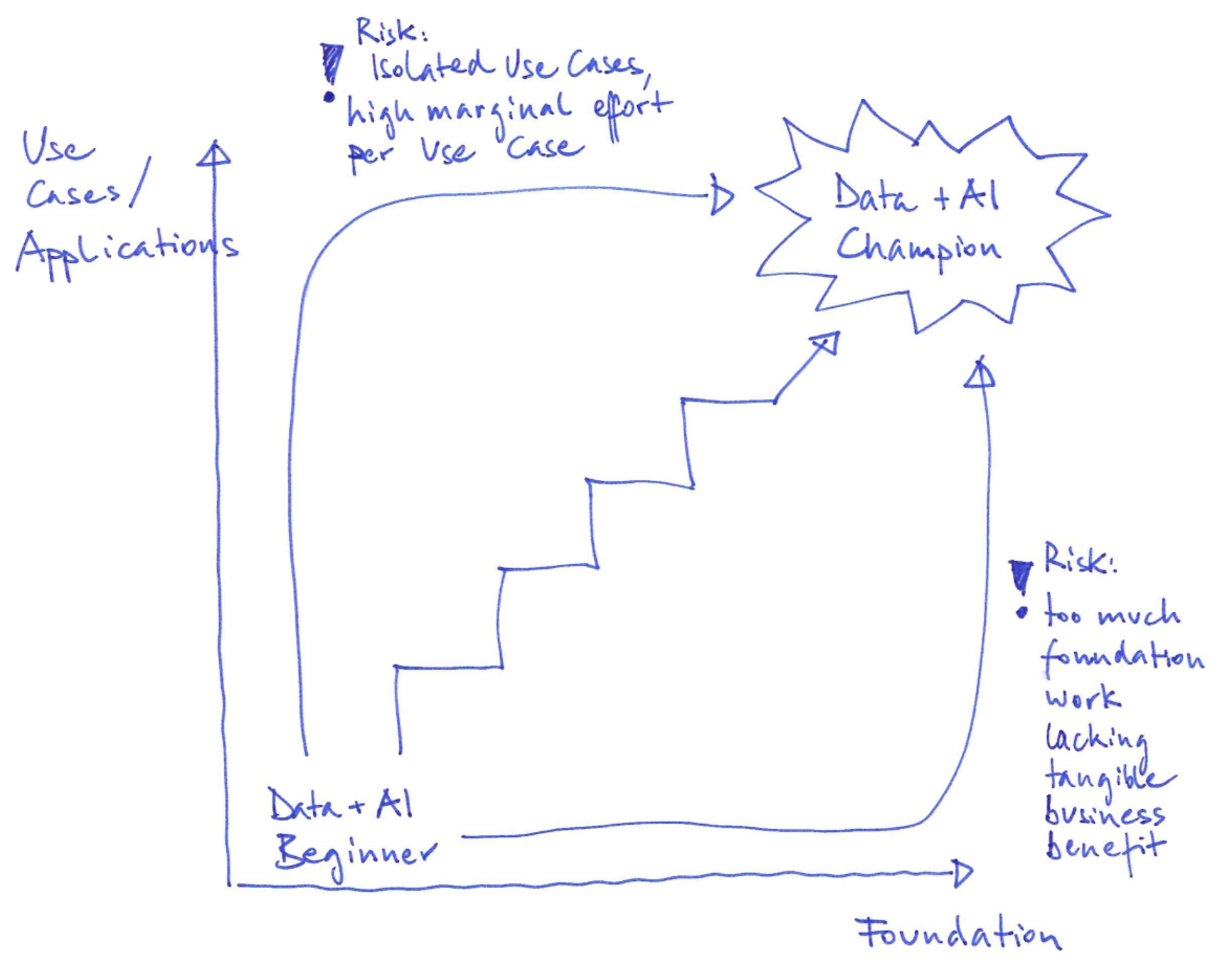
And then the overall approach should look more like a stepladder than a ruler. In this way, you build the foundation as more and more (relevant) use cases are defined and planned.
Start with the business goal, not the technology
Too often, AI work begins with platforms, licenses, and use cases. It feels concrete, and it creates momentum. However, I think the order is wrong.
An AI strategy should be based on the goals the company is already steering towards: e.g. growth, margins, customer satisfaction, compliance, resilience, faster execution, etc.
Only then does it make sense to ask: Where can AI change the work enough to actually move those goals?
The management task is therefore not just to respond to the current AI wave, but to prepare the organization for the business reality that follows right after. It is a difficult task. We can no longer run companies in the expectation of stability. Change is not an exception – it has become a basic condition.
Place ownership in the business
If AI is owned solely by IT, the success criteria often become technical: Is the solution live? Is the integration stable? Is security in place? Have a certain number of employees used the tool?
It’s all relevant. But that is not enough.
It is the business that must own the problem statement, the value creation and the behavioural change that is needed for the solution to actually have an effect. Because if no one changes the processes around an AI solution, it rarely becomes more than a convincing demo.
We see this again and again. AI pilots that never become operational because no one has translated them into a new way of working. First, it affects adoption. Then the winnings do not materialize. And eventually, it begins to hit the credibility of those who initiated the initiative.
Therefore, if you’re a CIO or technology manager, you should insist on joint ownership. Not to push the responsibility away, but to ensure that the responsibility is correctly placed.
In practice, every AI effort should have a business owner, a technical owner, and a risk owner. There must be clear decisions about data, compliance and responsibility. Otherwise, you quickly end up with a growing collection of trial balloons, unnecessary security risk, and cloud/token usage that runs ahead of value.
This is also where the company must decide on its risk appetite. Because not all AI initiatives require the same level of control. An internal writing assistant requires one form of control. An AI solution that influences customer decisions, credit ratings, or the processing of personal data requires something completely different.
Risk must therefore be linked directly to business value. Otherwise, governance will either be too heavy or too lax. But when ownership, responsibility and risk level are in place, the next – and often most difficult – question arises: What should we actually focus on?
Rasmus Korsager Ørtoft argues that the overall approach to AI should look more like a stepladder than a ruler. In this way, you build the foundation as more and more (relevant) use cases are defined and planned.
Govern AI as a strategic portfolio, not as individual projects
This is where many companies lose their grip.
AI is treated as a series of stand-alone initiatives: a pilot here, a copilot there, an experiment in a staff function, and perhaps an exciting proof of concept in a corner of the organization. Individually, they can be both relevant and promising. But together they do not necessarily constitute a strategy.
If AI is to create real value, it must not live as a side project or a small corner of the digital agenda. It must be managed as part of the company’s future business model.
It may sound big, but the point is actually quite simple: AI must be prioritized where it can change something fundamental. Not just make an existing task a little faster, but improve decision quality, change workflows, strengthen the customer experience, reduce risk or open up new ways to deliver and make money.
Therefore, a strong AI strategy is not a long list of ideas either. It is a prioritised portfolio of initiatives with a clear business effect, clear ownership and a conscious relationship to investment and risk.
I’d much rather see three AI initiatives that are closely linked to the company’s most important goals than twenty experiments with no real direction. Because it is rarely the amount of activity that determines whether AI succeeds. It is the quality of the prioritization.
This also means that the KPIs must be set before the technology is chosen. What is it specifically that needs to change? Shorter case processing time? Better forecast accuracy? Higher retention? Lower regulatory risk? Fewer manual bottlenecks in critical processes? Usage statistics can be deceiving. Many logins are not the same as new behavior. Many prompts are not the same as better decisions. And task-level performance doesn’t automatically equate to organization-level value.
This is also why so many AI initiatives look promising locally, yet don’t move the company as a whole. Not necessarily because the technology lacks potential, but because the work around it is not being redesigned, prioritized and management-anchored.
An AI portfolio must therefore be actively managed. What works must be scaled. What almost works needs to be adjusted quickly. And what does not move a strategic goal must be closed – even if it looks good in a demo or gives the impression of progress.
It requires discipline. But that is exactly where the difference lies.
Because AI transformation is ultimately not about having the most use cases. It’s about consciously using AI to shape the way the company will operate, compete and make money in the future.
From strategy to next decision
I feel like saying that an AI strategy is only strong when it can be used to say no.
No to use cases from outside that are not relevant. No to use cases without clear ownership. No to technology without a purpose that can be measured. No to pilots who do not change their work. And no to risks that no one really wants to take responsibility for.
Therefore, the best place to start isn’t a new platform or yet another use case you’ve heard about at an AI conference. The best place to start is by looking at your own business goals.
Choose one goal. Identify what’s holding it back. Find one AI effort that can make a real difference. And decide how to own, measure, and manage it.
Then AI is no longer just good intentions, but pure business – and a potential catalyst for future growth and innovation.


